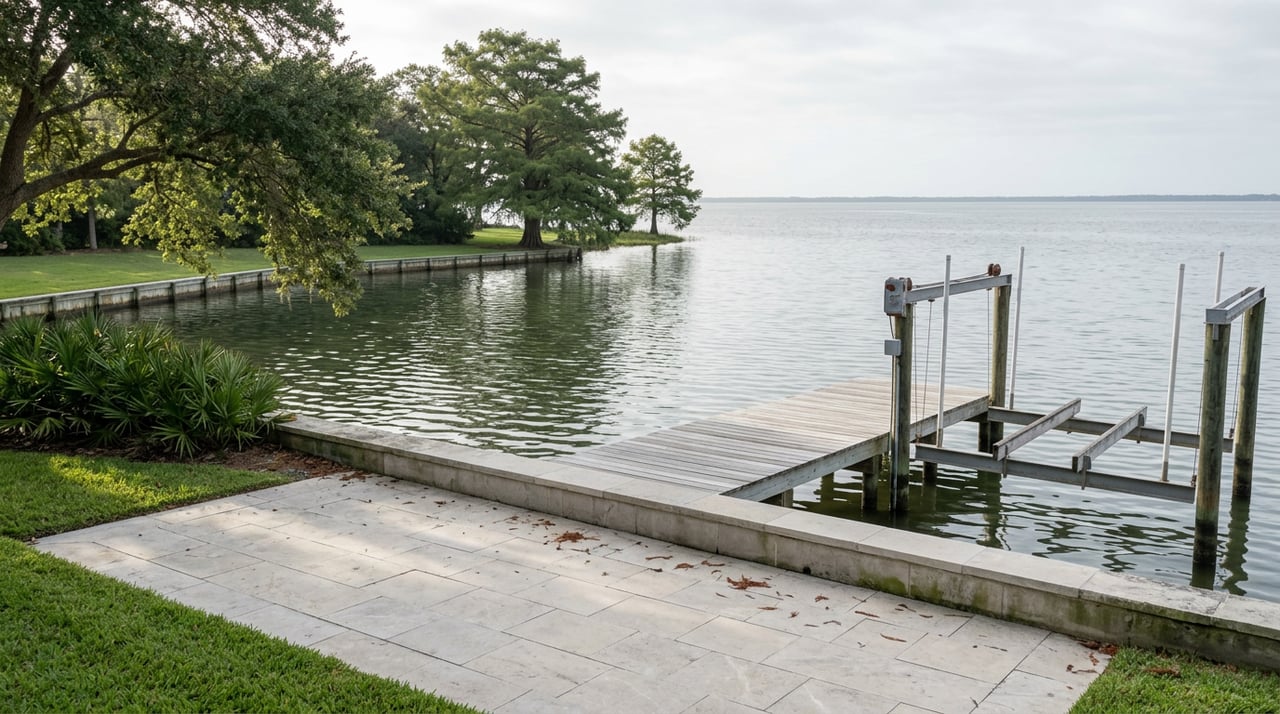
Buy a home on the water in Horseshoe Bay and you might assume the dock comes with it. It doesn't, not automatically. The Lower Colorado River Authority is clear on this point: owning lakefront property does not by itself grant the right to build or keep a dock. Before any structure goes in the water, the owner has to confirm who actually holds title to the submerged land beneath it, because in some cases that land belongs to a neighbor, or to LCRA itself, and building without permission is not an option.
That single rule says something bigger about how this market actually prices homes. Buyers arrive expecting the house to set the number, the way it does almost everywhere else. On the water in Horseshoe Bay, the house is often the smaller variable. What actually moves the price is what's attached to the deed and what sits below the waterline, and that gap between what buyers expect to matter and what actually matters is where the surprises live.
The Same Island, Two Very Different Prices
Two homes marketed on Applehead Island this year make the point better than any general rule could. One, at 112 Applehead Island, offered 7,152 square feet, a main house plus two casitas, a heated pool, and more than 220 feet of open north and northeast facing waterfront, and it listed at $9.5 million. Another, at 59 Applehead Island Drive, offered 3,554 square feet on the same guarded island, with the same security gate and the same property owners association, and it listed at $2.6 million after a price cut.
Run the math and the larger home priced out at roughly $1,330 per square foot. The smaller one priced out at roughly $730 per square foot. That's not a rounding difference. Two houses inside the same gate, under the same rules, with the same guardhouse controlling the single bridge onto the island, landed nearly $600 apart on a per-square-foot basis. Square footage alone cannot explain that gap. Frontage and position can. More linear feet of open water, a better facing, a longer dock footprint, and the price follows the shoreline rather than the floor plan.
Applehead Island itself is a useful reminder of how finite that shoreline actually is. The island isn't a natural formation. It was built by dredging roughly 400,000 cubic yards of earth to create it, a project that stretched the shoreline from about 8,300 linear feet to more than 13,000. Once that work was done, no more waterfront could be manufactured. Every foot of frontage on the island is a fixed, non-renewable asset, and pricing on the island reflects that scarcity directly.
What the Listing Photos Don't Show You
A few physical details do most of the work in setting a waterfront price, and none of them show up clearly in a standard photo gallery.
Linear footage of shoreline is the core unit of value. A lot with less than about 70 feet of frontage is tight for a single dock and boat slip. Somewhere in the 80 to 120 foot range tends to satisfy most full-time owners. Beyond about 150 feet, a lot starts trading in estate territory, the way the 112 Applehead listing did.
Water depth at the dock decides what can actually be tied up there. Deep water supports a cruiser or a wake boat. Shallow water limits an owner to pontoons and personal watercraft, and that limitation shows up in resale value even when the house itself is identical.
Dock and boathouse condition matters just as much as the water beneath them. A covered boathouse with a working lift and a clean permit history adds real value. A structure that's aging out costs the next owner money before they ever use it. Bulkhead condition sits in the same category. Replacing a bulkhead typically runs from about $50,000 to $200,000 depending on length and materials, so a buyer comparing two similar homes needs to know whether that expense is already behind the current owner or still ahead of the next one.
Orientation is easy to overlook and hard to ignore once you own the house. South and east facing waterfront gets morning light and afternoon shade, which matters more in a Hill Country summer than most buyers expect walking through a listing in cooler weather.
And subdivision status changes the number even when the shoreline looks the same. Owning inside a gated community like Applehead Island does not automatically include a Horseshoe Bay Resort Club membership or golf privileges. Those come with their own initiation fee and dues, separate from the homeowners association, and a buyer needs to confirm in writing what actually transfers with the sale rather than assuming it travels with the address.
| Frontage | Typical use case |
|---|---|
| Under 70 feet | Tight for a single dock and slip |
| 80 to 120 feet | Comfortable range for most full-time owners |
| 150 feet or more | Estate tier, priced accordingly |
The Lake Isn't as Constant as the Name Suggests
Buyers on Lake LBJ often hear the phrase constant level lake and treat it as a guarantee. LCRA's own language is more careful than that. None of the Highland Lakes, including LBJ, are true constant level reservoirs. LBJ falls into the category LCRA calls a pass-through lake, managed within a fairly narrow range under normal conditions but still able to fluctuate, particularly during a flood.
That distinction has practical weight for anyone evaluating a dock or a bulkhead. LCRA does not require a permit or a fee for a residential dock of 1,500 square feet or less, but every dock on the lake, regardless of size, still has to meet the agency's safety standards for flotation, lighting, anchoring, and distance from shore. LCRA also periodically lowers the pass-through lakes to manage vegetation and give owners a window to repair docks and retaining walls, which tells you the agency itself treats these structures as things that need maintenance on a cycle, not fixtures that were built once and forgotten.
None of this makes Horseshoe Bay a riskier place to own on the water. It means the stability implied by constant level shouldn't substitute for actually checking a dock's permit status and a bulkhead's condition before closing. The label describes normal operating behavior. It doesn't describe every structure sitting on every lot.
Before You Compare Two Listings
A few questions are worth asking before two waterfront homes get compared side by side on price alone.
Confirm who owns the submerged land under any existing dock, through the county deed records, not through an assumption based on the shoreline. Ask for the dock's permit history and current condition rather than taking the listing description at face value. Find out whether a resort club membership or golf privileges convey with the sale or require a separate initiation, since that single line item can represent tens of thousands of dollars either way. Get a straight answer on bulkhead condition and, if it's aging, budget for the $50,000 to $200,000 replacement range rather than treating it as someone else's future problem. And weigh subdivision dues and comparables the same way you'd weigh square footage, because two homes with identical floor plans in different gated communities are not actually the same product.
The broader market context suggests this waterfront premium isn't a short-term artifact. Horseshoe Bay Resort, which anchors much of the demand along this stretch of Lake LBJ, has put more than $350 million into enhancements over the past decade and has another $60 million planned for 2026 alone. That kind of sustained reinvestment tends to support the value structure around it rather than erode it, which matters if you're weighing a waterfront purchase as a long-term hold rather than a short-term bet.
A Few Questions Worth Asking Directly
Does every waterfront listing in Horseshoe Bay include dock rights? No. Ownership of the shoreline does not automatically include ownership of the submerged land beneath a dock. That has to be verified separately through county deed records before any structure is built or transferred.
Is Lake LBJ guaranteed to stay at the same level? Not by LCRA's own classification. LBJ is managed as a pass-through lake within a fairly narrow range under normal conditions, but the agency is explicit that it can still fluctuate, especially during flood events.
If I buy on a gated island like Applehead, do I automatically get access to the resort club and golf courses? No. Those memberships carry their own initiation fee and dues, separate from the property owners association, and should be confirmed in writing as part of the sale rather than assumed.
Comparing two waterfront listings on price per square foot alone will point you in the wrong direction more often than not on this lake. The shoreline, the depth, the dock's history, and what's attached to the membership tell the real story, and that's the kind of detail worth working through with someone who spends time in these subdivisions rather than just the listing sheet. If you're weighing a purchase on Lake LBJ or anywhere else in the Hill Country, Friedman Real Estate is glad to walk through what a specific property actually includes before you make an offer on it.